Profile
MA student
Latin literature, intersectionality, postcolonialism & gender studies
Ghent University
Email: Hind.Ayhir@ugent.be
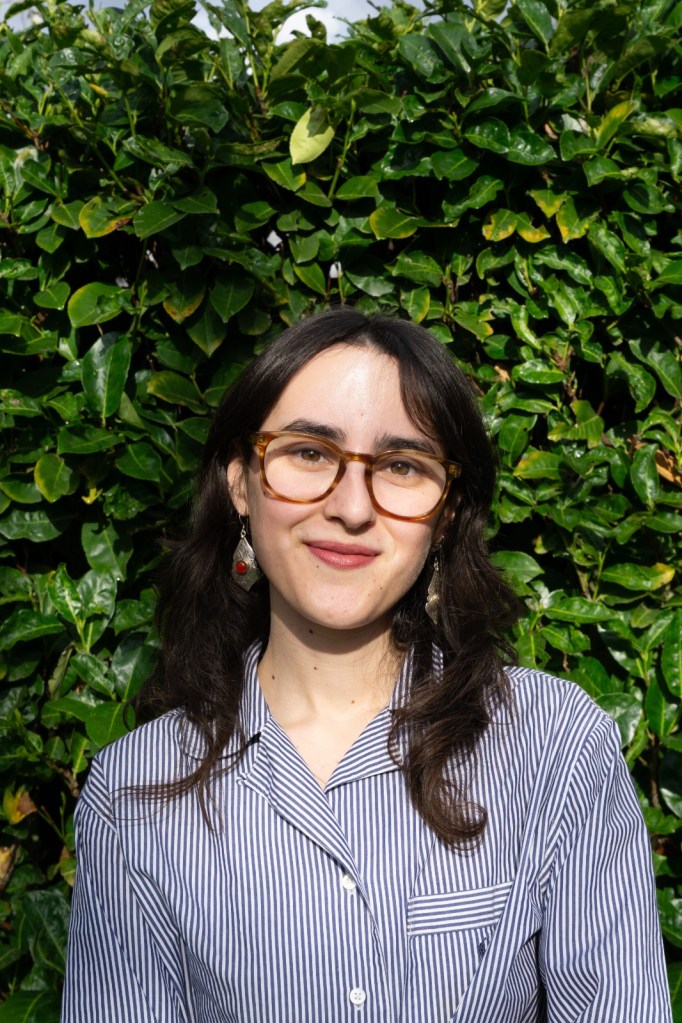
Hind Ayhir is a MA student in Historical Literature and Linguistics (Latin and Greek) at Ghent University, where she is writing a master’s dissertation on gender performativity and polyphony in the letter collection of Laura Cereta. Earlier she obtained a BA in Literature and Linguistics (Latin and Greek). She is interested in all forms of autobiographical or self-life writing, in conceptions of alterity, diasporic identities and cultural exchange, and in reading literature with insights gained from various theoretical approaches such as intersectional feminism, queer theory and reception studies. In addition, her work seeks to apply postcolonial, decolonial and anti-racist approaches to the study of Latin literature.
“Academics stand idle. That is, until the dust settles, then they will write books about what should have been. Coin terms and such. Lecture in the past tense.”
― Mohammed El-Kurd, p.8
Perfect Victims: And the Politics of Appeal (2025)
The central question that preoccupies me, in my research and in daily life, is whether we – scholars, students, academics – can meaningfully contribute to social and political change in the world; or whether, as the statement above indicates, we can only write books after the fact, hide behind a past tense while we are passive witnesses to the atrocity of genocides and epistemicides. These past years, this question felt increasingly important to me but also particularly relevant for the study of Latin, which has historically been implicated in the justification and upholding of colonialism, white supremacy, and patriarchy.
My work is driven by the question of how we can dismantle the oppressive systems and the harmful epistemologies rooted in coloniality and patriarchy that have defined the field of Latin studies. In order to facilitate that process, I believe we have to confront the past head-on, especially the ‘dark times’. No romanticising, no glorifying. In my work, this translates itself into a critical examination of the role of the Latin literary production in the Early Modern and Modern period and the ways it helped shape and consolidate the systems of oppression still present in contemporary society.
But aside from the ways Latin has contributed to harm, I am also interested in tracing a tradition of resistance and counter-narratives written by marginalised authors who challenge and subvert authority simply by speaking, or who question hegemonic epistemologies through their writing. Authors like Hasan al-Wazzan (known as Leo Africanus), Juan Latino, Laura Cereta, Sor Juana Inés de la Cruz, Phyllis Wheatley, but also modern authors like Countee Cullen and Toni Morrison.
RELICS’ framework offers us this opportunity, to study Latin from a broad perspective; to move temporally beyond antiquity, to study Latin literary tradition in its entirety, up until modern times; to travel, so to speak, geographically all over the globe in search of authors and texts written out of the canon. The approach of RELICS also opens up an avenue for exploring the moments of confluence between cultures, traditions, languages. For me, the Arabic-Islamic world, specifically the culture and history of the Maghreb and its encounters with Latin and Europe, holds special interest.
Another important point the vision of RELICS reminds us of is that research, language, and history are never neutral, impartial or a-political. I wish to return here to El-Kurd’s passage cited above, which I read as a call to action applicable to Latin literary studies as well as to research in general. This call, I think, boils down to the following question: “Will we stand idle and wait until the dust settles, or will we learn from the past to build a better, anti-colonial, and justice-focused future?”
 RELICS