
On Friday 2 October 2026, one of the key inspirations behind the RELICS network, Professor Wim Verbaal, celebrated his emeritus status. Although this is by no means a goodbye, the occasion provided an excellent opportunity for Jeroen De Gussem and Dinah Wouters, both RELICS members and his disciples, to reflect on Wim’s remarkable academic career, his lasting impact on the study of Latin literature, and the intellectual legacy he leaves to generations of students and scholars.
One day, in the summer of 2024, I killed Wim Verbaal’s goldfish. You know, the ones in the tank in his office in the Blandijn. It was an accident, of course. I remember losing my breath and turning pale. I vaguely remember that, in a blind panic, I even phoned my partner, who could not really do anything to help, of course, while I rattled on incoherently that I had just entered Wim’s office and found the goldfish there, or rather, what had by then become black fish, with white eyes, all bloated and partly dissolved in the algae, quite dead, I believe.
Now, Wim was never one to give me chores, but just this once he had entrusted me, during a brief absence abroad in the course of his July holiday, with watching and feeding his goldfish. I had been doing so quite successfully for some time, and had visited them several times to make sure that everything was in order. That day was supposed to be my final visit to feed them.
It is hard to describe the sense of despair and guilt that washed over me at that particular moment. My partner, meanwhile, was doing her best to reassure me over the phone, saying, “Just be honest about it!”, but there was a kind of white heat pulsating through my veins. I finished a WhatsApp message to Wim, pressed send, left the office, and probably sobbed to my partner one last time that I could not believe the nightmare I had just walked into and that this day could not possibly get any worse, when I stepped into the hallway, looked to my right, and saw… Wim. Coming down the corridor. Back from his travels two days earlier than I had thought. It was a Thursday, and I had thought he was returning on Saturday.
And from the other end of the hallway he shouted something at me with a big smile: “Busted!” This, of course, had nothing whatsoever to do with the message I had sent him on WhatsApp five seconds earlier, but at that very moment our eyes met, and he must have seen my utter consternation, and I had to tell him, right there and then, that I had killed his goldfish.
Fortunately, Wim has the rare gift of seeing through a situation straight away and giving it precisely the emotional handling it requires. He told me, of course, that this was far from the first time his goldfish had died. Fortunately, though I had not known this, his emotional attachment to them was very slight. He understood that I had done my best, but suggested that perhaps I had given them too much food. In brief, he told me everything I needed to hear, and in the end, we went our separate ways, after he had reassured me a hundred times over that everything was fine, and concluded that, indeed, there must simply have been something in the water of the Blandijn.
Here we are, Dinah and I, to paint a portrait of Wim Verbaal. How exactly are we to do that? You can, of course, tell a great deal about a man from the way he reacts when someone he trusts has just killed his goldfish, though perhaps not everything. To describe Wim Verbaal at today’s emeritus ceremony seems to us the most difficult, though undoubtedly not the last, in a long series of challenges that only Wim Verbaal could have devised for us. The task is simply impossible. How typically Wim Verbaal. Unfortunately, saying that someone’s career cannot be summarized on an occasion such as this is a cliché. Some may therefore be tempted to doubt either the sincerity or the truth of that statement. But those in this room who know Wim well will agree with me that, this time round, we may consider it true. No all-encompassing portrait can be painted of a man whose interests and knowledge extend so far beyond what is conventionally understood as Latin literature. Moreover, Dinah and I entered Wim’s long career relatively late and can therefore reliably shed light on only a small part of it. Every year, we continue to discover new things about him. Do I even know Wim Verbaal? Does anyone in this room know him at all?
The genre of the Vita requires me to look back to Wim’s beginnings—a period to which I was, obviously, not yet a witness, and which, I must admit, remains irretrievably shrouded behind the kind yet mysterious smile so characteristic of Wim telling me about it. In those beginnings, however, immediately the non-conventionality of Wim’s trajectory emerges. Wim’s first choices did not predestine him to the study of Latin or to a doctorate in classical philology. As we shall see, the defining thread running through his career in Latin literature was exactly how it was never just confined to Latin alone. Perhaps it is possible to say that Wim’s first interest is and has always been humankind and human nature. He is fascinated with the ways in which humans situate themselves in the world and the universe, and struggle (indeed, often fail) to understand their surroundings. Academics are in this sense a special breed of human, for their admirable intelligence is weighed down by a great vice: that of conceit. We’ll get back to that.
Wim first sought answers in biology, which he studied in the Landbouwhogeschool in the Netherlands, his native country, in Wageningen. He has often reflected on this formative period as one in which he became acutely aware of the limitations of exact sciences. It was there that he developed a lasting scepticism towards empiricism and positivism, and towards rigid, preconceived frameworks that risk binding scholars to their own dogmas.
If this might make Wim sound like a postmodernist or a relativist, you are very mistaken. I have never seen Wim give up on attaining truth. He also has a very fond heart for history and he even likes some historians. Wim once told me that he regarded history as the grammar of literature. And there is also a beautiful quote in his valued book chapter on fiction: “man’s history is no snakeskin left behind without leaving any traces.”
Wim is fascinated with how human beings engage with the truth, and how those engagements reveal as much about truth as truth itself. From fictions and forgeries to the darkest reaches of the human imagination, these were the worlds that captivated him, and the Middle Ages are a great period for it. Nothing puts a bigger smile on Wim’s face (there it is again, the Wilhelm smile) than telling you about how, for example, the Capitoline wolf is not an Etruscan masterpiece but a medieval copy, or how nearly all the faith we put in ‘classical’ Latin is in the hands of Carolingian scribes.
So in order to contribute to obtaining some truth in these domains, Wim changed tracks and went to study Latin. He also exchanged the Netherlands for Belgium, and over the years adopted many of the good characteristics of the Belgians, but none of the bad ones. In 2000, he obtained his PhD under the supervision of Prof. Dr. Marc Van Uytfanghe on the writing strategies of Bernard of Clairvaux (entitled “A Divine Tragedy. Triumph and Defeat in the Word by Bernard of Clairvaux”). It turns out, by the way, that this thesis has become notoriously hard to find. The librarians here in Ghent, who greatly appreciate Wim by the way, and collaborated with us eagerly so as to help us get hold of a copy, had to admit to some embarrassment that the thesis was badly damaged by mould. We could regret that, or we could see it as the symbiosis of nature and culture, symbolic of Wim’s career. Later publications are fortunately better preserved, such as his first book which integrates much of his previous somewhat more fungal thesis: Een middeleeuws drama, revolving around the clash between the twelfth-century Cistercian abbot Bernard and the contemporary school master and dialectician, Peter Abelard. In 2005, Wim became Professor of Latin Language and Literature at Ghent University.
Wim is a thinker who dares to question everything. Another piece of advice of his that comes to mind here is something he once told me: that to understand any subject matter, you must approach it as though it were not you who was trying to understand it, but as the ‘other’; you must, indeed, come at it from the outside. Only then will you be able to see just how strange, complex, even unsettling your subject matter is, and only then will you be able to look it in the eye. If you are lucky, you may even have demystified it a little: you will see just how problematic your own way of looking at it had been, how readily you had relied on the viewpoints of others, viewpoints that now turn out not to make any sense at all, and this reacquaintance with your subject will startle you and make you truly passionate about what you are doing.
What does this have to do with Latin? Everything, Wim would reply. Both Dinah and I can attest that to be taught by Wim is to be made to question why you are studying Latin in the first place, and what its attraction actually consists in. Wim’s insights have this effect on his disciples and colleagues all the time. His work challenges us to confront the foundational assumptions of our discipline. And when those foundations are shaken, the whole world trembles with them, because, yes, Wim would argue that Latin is foundational. That does not mean that it is always visible, nor that it offers us a pretty picture of Europe and its past. Perhaps it will suffice here to repeat a remark allegedly made by Wim to a student, and soon to appear in print: “Latin is like rats: it is everywhere, but people fail, and fear, to see it.”
Indeed, just in his attempt to study Latin by trying to read not as a Latinist, Wim was successful in aptly showing how the field suffered from a bias toward antiquity and the classical authors. It became a career-long marvel to him why the field of Latin remained intent to ignore 99.998% of its literary corpus, which is roughly the number you get once you disregard the canonical Latin writers of the late Republic and the early Empire. Wim knew these authors perfectly well, of course, and loved reading them. At the same time, he reacted his entire career against the forces of classicism that dominated the approach to Latin. His scholarship urged us to break free from the legacy of 19th-century classical philology and to think in new ways about Latin – not as the other half of “the classics”, not as a cultural derivative of Greek.
Wim often asked why we measure Medieval Latin by the standards of classical literature, rather than allowing it to stand on its own terms. Wim’s latest book about the Loire poets is a great example of this approach, showing that to recognize that a poem is inspired by Ovid, or Vergil, or Horace, and to measure it by these classical poetics, can only ever be the first step. Other questions must follow: why are poets actually doing this, what are the intentions behind it, are others doing this as well, what does this tell us about their contemporary literary culture? Wim teaches us that classicizing (following classical models) is not at all the natural way of the world: teaching it in schools is an institutional choice, and writing like this is also a choice that can be driven by various esthetic and political considerations.
Insofar as students today voluntarily choose to study Latin language and literature, we must be able to explain to ourselves why we do so and what we hope to learn from it. And, indeed, if we once again approach the subject from the outside, how defensible is it to restrict a reading list for Latin literature to the writings of a select, exclusively male senatorial class from a brief period some two thousand years ago?
Wim seized every possible occasion to present an alternative. Latin is a cosmopolitan language and, once again, looking at it from the outside makes us realize this all the more clearly: its functioning across time, space, and systems of belief has much in common with that of literatures that stand alongside Latin and possess a similar status, such as Arabic, Byzantine Greek, Sanskrit, and Hebrew, literatures that are too often treated in isolation. In Latin’s postclassical period, we encounter all the more this role for Latin that negotiates between cultures, that acts as a catalyst for the full development and flowering of vernacular literatures rather than as their adversary. We encounter a Latin written and consumed by a far more diverse audience. The legacy of these ideas of Wim lives on in the research network RELICS: Researchers of Latinate Identities, Cosmopolitanism, and the Schools.
Wim set the bar high, both for himself and for others. As a result, his mastery extends across the full spectrum of a literary work’s dimensions, from metre and rhyme to codicology and manuscript illumination, and from the intricacies of theories of fiction to the broader currents of intellectual history. His keen eye uncovers the literary depth, irony, and fictionalization in texts often read merely as historical or theological sources. Take, for example, his reading of Abelard’s Historia Calamitatum or John of Salisbury’s Historia Pontificalis: Wim reveals the artistry and intention behind works too often treated as neutral accounts. Or consider his work on the arrangement of letter collections, such as those of Hildebert of Lavardin, where he demonstrates that chronological or addressee-based orderings obscure the thematic concatenations between letters and the greater spiritual-pedagogical designs at play. He reads Abelard not just as a historical source, but as an author—and Bernard not merely as a theologian, but as a literary figure. For Wim, the question is always: What does the literature do?
But Wim’s knowledge and expertise range far beyond the twelfth century. He is as much at ease with Vergil or with the literature of the seventeenth century. We as his former PhD students bear testimony to this, as the topics of our dissertations ranged from Antiquity up to the twentieth century and everything in between.
Wim is a talented pedagogue and unforgettable teacher. He himself has written about figures like Bernard of Clairvaux and Peter Abelard as charismatic teachers: pedagogues and speakers who draw people to them as much for how they teach as for what they teach. We would not hesitate to place Wim in this category too (notwithstanding the fact that they supposedly died out around the first decades of the twelfth century, according to the theory of Stephen Jaeger). Like Bernard, Wim weaves narratives that captivate, building tension and imbuing his stories with emotional, spiritual, and political resonance. And like Abelard, he thrives on debate. The best thing you can do for Wim is to contradict him; the worst is not to engage at all.
Teaching, for Wim, has always been more vital than the pursuit of publications or promotions. It is what truly matters in the university. Instead of repeating courses over the years, he came up with new topics, texts and approaches each year, keeping himself and everyone else sharp and on the edges of their seats.
There are many students in this room. To many of them, Wim has meant a very great deal, and he has never lost faith in them. They should know that, over these past few years, despite a growing societal pessimism about education, I have frequently heard him say, and I am sure many others in this room have heard him say the same, that he genuinely believed the new students he met each year were only getting better. And I can assure you that this means a great deal coming from Wim, who, as I also know, does not take quite so positive a view of everything concerning the future.
We appreciate Wim’s outstanding mentorship and his unfailing fight against injustice in academia. Although, as we have argued in the opening of this speech, Wim’s academic quest was to find out about human nature, he did come to realise how hard it is sometimes to find the human in academia. Again, we find a parallel in his own work about Abelard and Bernard: about this famous clash, he has argued that this was not just about two individuals who could not stand each other, and not solely about two opposing worldviews either, but also about the authority of institutions and the protection of power, forces that were largely beyond their control.
Wim Verbaal has been an inspiring teacher, trusted colleague, and good friend to many of us present here today and even more people who are not present at this celebration. His legacy will live on through many people, in many ways, and for a long time to come.
———
Jeroen De Gussem and Dinah Wouters
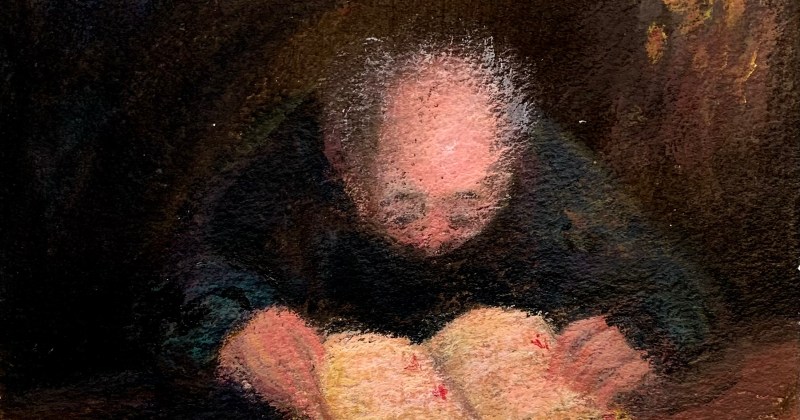
The featured image was made by Gunilla Iversen (“Captured by the Text”)
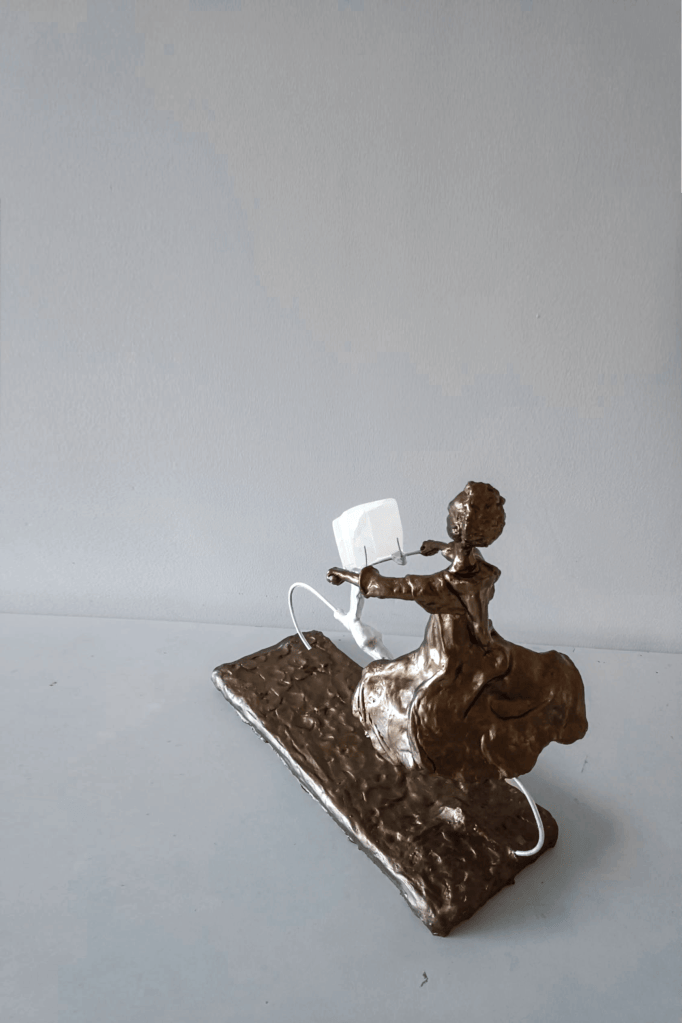
and the sculpture was made by Manuel Mertens (“Monachus in bicicletta”)
Thank you: Kristin Bliksrud Aavitsland, Hind Ayhir, Yannick Bellemas, Sarah Bowden, Mette Bruun, Anders Cullhed, Hannelore Debouvère, Jeroen Deploige, Jeroen De Gussem, Piet Gerbrandy, Babette Hellemans, Vincent Hunink, Kacper Jędrych, Mike Kestemont, Theo Lap, Yanick Maes, Peter-Jan Marichael, Máire Ní Mhaonaigh, Ingela Nilsson, Tim Noens, Linde Nuyts, Tom O’Donnell, Cyriel Pattyn, Joshua Pint, Rosa Rodriguez Porto, Stijn Praet, Burcht Pranger, Maxim Rigaux, Lode Sans, Anna Santermans, Klazina Staat, Francesco Stella, Jean-Yves Tilliette, Elizabeth Tyler, Berence Verhelst, Julian Yolles

