
by Dinah Wouters
What do Vergil, Ovid and Cicero have to do with the Dutch colony of Brazil, medieval Crusaders, or fascist colonization in Libya? More than you would think, demonstrates our anthology Classical Receptions and Settler Colonialism: A Reader. We make this case not with theory, but with the primary sources themselves, presented with fresh English translations and accessible introductions.
The book is a product of the research network Settler Colonial Paradigms (SECOPS), based at the Royal Netherlands Institute in Rome (KNIR) and the University of Groningen. Our central premise is that receptions of Greco-Roman and Biblical antiquity were fundamental to the genesis, structure, and legitimation of settler colonial societies. Rome was, as I and my co-editor Susanna de Beer show in the introduction, the “parent of empires.” When early modern Europeans spoke of empire, they meant the Roman Empire; when they spoke of a colony, they meant the Roman colonia. Concepts like translatio imperii, the Trojan foundation myth, and the Roman law concept terra nullius gave settler projects a vocabulary of rightful inheritance and civilizing destiny.
The volume shows that Latin was a working language of empire: Neo-Latin epic, epigrams, letters, legal treatises, and surveying manuals reflected but also shaped how settlers imagined, justified, and administered colonization, from Justus Lipsius’s treatise on Admiring Roman Greatness to fascist Latin poetry. This inheritance was remarkably malleable. Depending on context and need, writers could cast the Romans as civilizers or as brutal oppressors, praise the Republic or the Principate, and elevate Greek “non-interventionist” colonization above Roman assimilation or vice versa. Even critics of empire worked with Roman materials, warning that luxury had corrupted the Republic, or that Roman cruelty toward the Iberians should shame the descendants of those Iberians, the conquistadores who themselves became tormentors and enslavers.
Crucially, we argue for reading reception as a continuum rather than as isolated borrowings. The classics are not a sealed tradition that later colonizers reached back to from a safe historical distance; our very idea of the classics is partly a product of colonialism and imperialism, which leaned so heavily on classical models. The book therefore asks not only how the classics shaped colonialism, but also how colonialism shaped our picture of the classics. It also insists that classical and biblical reception be studied together, since Scripture and the classical canon formed the twin pillars of European education and were constantly intertwined in colonial discourse. This has consequences for how we teach Latin today. As we ask in our introduction: if Latin and the classics have literally been involved in colonization and have metaphorically “colonized” global knowledge systems, what is our responsibility as teachers and scholars today?
What’s inside
The reader spans nearly three millennia in ten chapters. Jeremiah Pelgrom’s chapter brings together archaic Greek and Hebrew sources about colonization from 800–480 BC: passages from Homer’s Odyssey and Iliad concerning the founding of colonies, elegiac verses by the poets Archilochus and Mimnermus, Exodus narratives about a promised land, and the Carthaginian sailor Hanno’s Periplus, an account of a sea voyage along the West African coast. Even in these earliest texts, themes recur that would resonate for millennia: lush ‘empty’ lands awaiting colonists, disappointment upon arrival, the contrast between indigenous ‘wilderness’ and the imposed colonial order, and the displacement of indigenous peoples, presented as divinely sanctioned.
There follows a chapter on Roman colonization and literature of a more technical nature. Ancient Rome provided the legal and technical framework for land acquisition. Anouk Vermeulen’s chapter on the Corpus Agrimensorum Romanorum (Roman treatises on land surveying, including the works of Frontinus, a surveyor from the first century AD) demonstrates that these seemingly practical manuals were deeply ideological. Copied and adapted over the centuries, they naturalised imperial control and rendered indigenous claims invisible by presenting the landscape as an empty space that had to be organised in an orderly manner. Those who held power over language and law were able to make land ownership ‘writable’ and thereby render this ownership ‘true’.
Later, humanist scholarship drew on and expanded this repertoire. I present two chapters from Admiring Roman Greatness (1598) by Justus Lipsius, one of the most influential humanists of the Low Countries, whose treatise on Roman institutions was read throughout Europe. Lipsius treats colonists in a purely instrumental manner: as pawns for border defence, labour and alleviating overpopulation in the mother country. Colonisation thus becomes a form of social engineering, in which the relocation of the poor and the exploitation of conquered territory become necessary for imperial stability.
Because Rome presented itself as a civilisation founded by migrants, primarily through the journey of the Trojan refugee Aeneas in Virgil’s Aeneid, who founded a divinely ordained state from the ashes of Troy, the Roman founding myths provided powerful models for later colonial ventures, making settlement seem normal and ‘purifying’ the violence associated with it. Two chapters illustrate this epic heritage in action. Lukas Reddemann presents Johann Bodecher Benning’s Epigrammata Americana (1639), a collection of Latin poems that glorifies the Dutch conquests in Brazil in the style of Roman triumphal poetry, whilst my own second chapter analyses the Dutch Neo-Latin poet Caspar Barlaeus, whose poems from 1629–1630 present the conquest of the Brazilian city of Olinda in epic terms as a continuation of Roman imperialism. At the other end of the historical spectrum, Katharina-Maria Schön demonstrates how the Italian fascist poet Taberini employed Latin poetry to portray the Italian empire as the direct heir to Rome, depicting Africa as an empty space to be filled with the Greco-Roman civilization and Christianity.
But these same exempla could also serve as a warning. Barlaeus’s poems are ambiguous about colonial wealth, for fear that it might corrupt the Republic as it had purportedly done to Rome. Tycho Maas introduces Johannes Gulielmus de Grevenbroek, a Dutch colonial official at the Cape of Good Hope, whose Latin letter from 1695 on the Khoikhoi peoples challenged the prevailing perception of ‘primitivism’ and argued that non-Christian indigenous peoples often behaved in a more Christian manner than the colonists themselves. And the chapter by den Hartogh, Goudriaan, van Klinken and Stoutjesdijk discusses the Dutch minister Cornelius Van Velzen, whose theological work from 1748 sought out unconventional biblical passages in order to condemn slavery, demonstrating what it took to interpret both Roman law and Scripture against the grain.
The collection also addresses cultural elimination: forced assimilation disguised as ‘civilisation’, implemented through conversion and a classical education. Teddy Delwiche presents the Latin letters of Caleb Cheeshahteaumauk (c. 1665) and John Mettawan (1735/6): two Indigenous students at Harvard. They wrote artful Latin letters to their patrons, thus being required to embody the workings of ‘civilisation’ and internalising the frameworks that denied their people sovereignty.
Finally, the collection explores the triangular relationship between the metropolis, the colonists and the indigenous population. Ivo Wolsing analyses William of Tyre, the twelfth-century chronicler of the Crusader states, whose History of Jerusalem constructed a colonial identity that was neither wholly European nor indigenous, thereby erasing Islamic and indigenous claims to the land. The colonist, he explains, is the ‘intermediary’ or ‘translator’ who transposes the classics into a new context, and who, ultimately, by appropriating indigenous names or traditions that he simultaneously seeks to erase, embarks on a quest for his own indigenous identity.
In sum, the classical and biblical narratives were intertwined, flexible and powerful. They legitimised conquest, occasionally criticised it, and conferred cultural authority, a legacy that is still evident in today’s hierarchies of knowledge.
A reader for the classroom
This is a book designed to be used. Each chapter pairs an expert introduction with source texts and English translations, opening the field to students and scholars within but also beyond Classical Reception studies, in history, colonial studies, law, and theology. For Latin courses it offers ready-made, teachable case studies.
For this purpose, the reader is fully accessible online in open access.
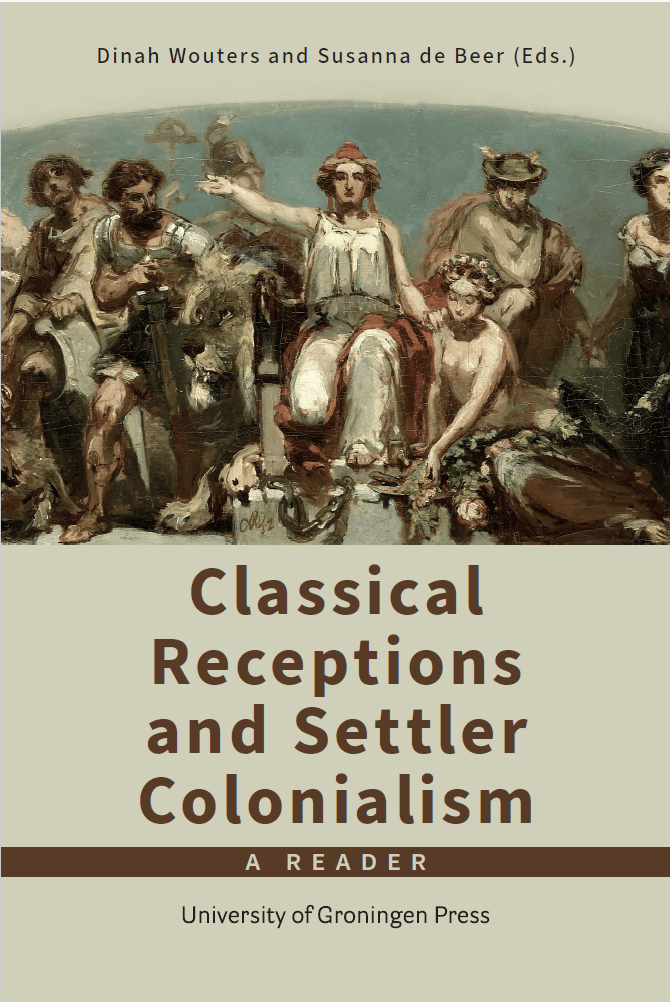
Classical Receptions and Settler Colonialism: A Reader. Edited by Dinah Wouters and Susanna de Beer. University of Groningen Press, 2026. https://books.ugp.rug.nl/ugp/catalog/book/298